
Sepang International Circuit Track Guide: Corners, Straights & Viewing Areas
Explore the Sepang International Circuit track layout, all 15 corners, long straights, key overtaking zones and the main viewing areas for F1 fans attending the 2026 race.

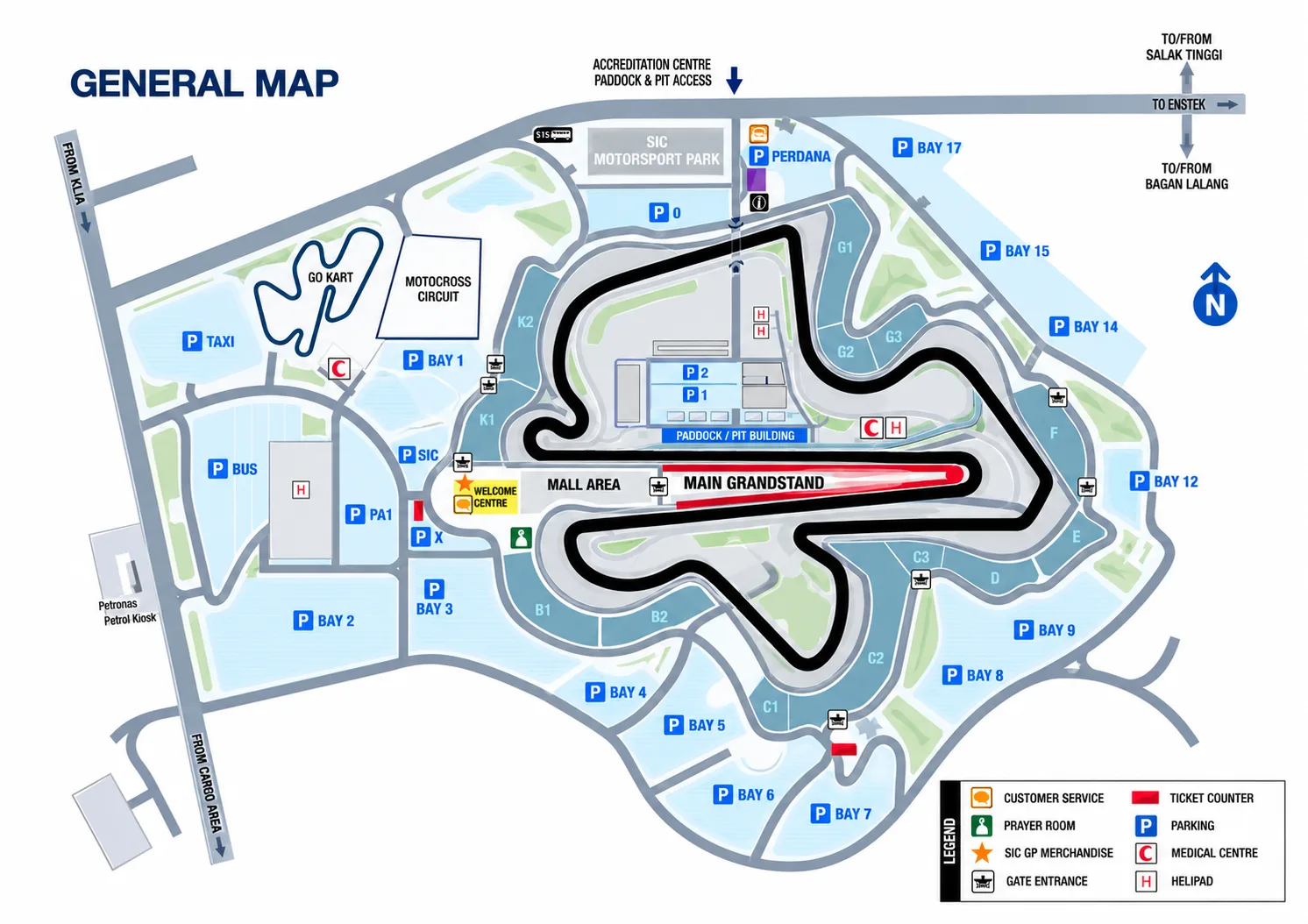
Image credit: Sepang International Circuit – General Map
The map gives you a useful overview of the entire circuit, including the main track, Main Grandstand, K1, F, K2 and other viewing areas, as well as parking, entrances, the Welcome Centre and surrounding facilities.
The circuit's official spectator maps also show multiple parking areas, shuttle stops and access points around the venue.
Tip: If you're attending F1 Sepang 2026, save the circuit map on your phone before heading to the venue. Sepang is a large site, and your parking area or entrance may not be directly beside your grandstand.
Understanding the Sepang Track Layout
The Sepang layout is designed around a combination of long straights and demanding corners.
The circuit is particularly interesting for spectators because the wide track creates different racing lines and several heavy braking zones.
Formula 1 describes Sepang as a circuit combining long straights, heavy-braking zones, fast flowing corners and multiple racing lines.
The lap can broadly be divided into three sections:
- Turns 1–4 — heavy braking and acceleration
- Turns 5–11 — flowing and technical middle section
- Turns 12–15 — fast corners leading into the long back straight and final hairpin
Turn 1 — The First Major Braking Zone
Turn 1 is one of the most important corners on the circuit.
Cars approach it after the long start/finish straight before braking heavily for the right-hand corner.
Because the cars arrive at high speed and the track is relatively wide, Turn 1 is one of the areas where fans can expect plenty of racing action.
It also immediately leads into Turn 2, making the opening sequence more complicated than simply braking for one corner.
What makes Turn 1 interesting?
- Heavy braking
- High-speed approach
- Cars can run close together
- Important for the opening lap
- Exit affects the run through Turn 2
Formula 1 highlights the opening sequence and Sepang's wide layout as important characteristics of the circuit.
Turn 2 — The Tight Left-Hand Corner
Turn 2 follows immediately after Turn 1.
The direction changes from right to left, creating a tight combination that tests how well the driver can position the car after the initial braking zone.
The corner also drops away compared with the approach to Turn 1, making traction particularly important on exit.
For spectators, Turn 1 and Turn 2 are best understood as a single racing sequence rather than two completely separate corners.
Turn 3 — Long Right-Hand Sweep
After Turn 2, the cars accelerate into the long right-hand Turn 3.
Unlike the slower opening corners, Turn 3 allows the cars to build speed and carries the lap towards the next braking zone.
This is one of the sections where the car's aerodynamic balance becomes increasingly important.
A strong exit from Turn 2 helps the driver carry speed through Turn 3 and towards Turn 4.
Turn 4 — Langkawi Curve
Turn 4 is a sharper right-hand corner after the long run through Turn 3.
It creates another braking opportunity before the circuit opens into the faster Turns 5 and 6 sequence.
This corner is important because drivers need to balance braking with a clean exit.
A mistake here can compromise the run into the next section.
Turns 5 & 6 — The Fast Flowing Section
Turns 5 and 6 form one of Sepang's most recognisable high-speed combinations.
The cars transition from a left-hand corner into a right-hand corner while maintaining considerable speed.
This section is less about simply slowing the car down and more about maintaining momentum.
The combination is also important for tyre management and aerodynamic stability.
Historically, Formula 1 has described the Turns 5–6 section as a high-speed sequence that puts significant load through the cars.
From a spectator's perspective
This section is particularly interesting because the cars don't simply brake, turn and accelerate.
Instead, you can see:
- Rapid direction changes
- High-speed cornering
- Cars moving through different racing lines
- Visible aerodynamic movement
- Drivers balancing speed and tyre grip
Turns 7 & 8 — The KLIA Curve
Turns 7 and 8 form another flowing right-hand sequence.
The cars carry significant speed through this section, with the two corners working together as one continuous sequence.
This is one of the areas where a small mistake can affect the next part of the lap.
The driver needs to position the car correctly through the first part of the complex before preparing for the next braking zone.
Turn 9 — A Tight Hairpin
Turn 9 represents a significant change in character.
After several fast corners, the cars arrive at a much slower left-hand hairpin.
This creates a strong contrast between the high-speed middle section and the slower technical corner.
Turn 9 is also important because drivers need good traction on exit to carry speed into the following section.
For fans watching from around this part of the circuit, Turn 9 gives you a very different view of the cars compared with the fast Turns 5–8.
Turns 10 & 11 — Technical Transition
After Turn 9, the circuit flows through Turns 10 and 11.
This section requires the driver to manage braking, steering and acceleration together.
Turn 11 in particular is part of the transition from the slower section into the faster final sector.
The important thing here is not simply how quickly the driver enters the corner, but how well the car is positioned for what follows.
Turn 12 — Fast Left-Hand Corner
Turn 12 begins the final major sequence of the lap.
It is a fast left-hand corner that leads towards Turn 13.
Unlike the slow hairpins earlier in the lap, this section places greater emphasis on maintaining speed and controlling the car through a fast change of direction.
This makes the final sector one of the more visually interesting parts of the circuit.
Turn 13 — Fast Right-Hand Corner
Turn 13 follows Turn 12 almost immediately.
The two corners work together as a fast left-right sequence before the car reaches Turn 14.
The driver needs to maintain momentum while preparing the car for the heavier braking that follows.
For fans watching this section, the cars can look significantly faster than they do through the slower corners around Turns 1, 2, 9 and 15.
Turn 14 — Final Corner Before the Back Straight
Turn 14 is an important corner because its exit directly influences the run onto the long back straight.
That makes the corner more important than its position on the map might initially suggest.
A driver may not necessarily gain the most time by entering Turn 14 aggressively.
Instead, getting a clean exit can be more valuable because it determines how quickly the car accelerates towards Turn 15.
Turn 15 — The Final Hairpin
Turn 15 is one of the most distinctive corners at Sepang.
It is a tight left-hand hairpin connecting the back straight to the main start/finish straight.
This is also one of the circuit's major overtaking areas.
Cars brake heavily at the end of the back straight before turning into Turn 15.
The corner then leads directly onto the main straight, creating another opportunity for slipstreaming and attack into Turn 1.
Formula 1 specifically highlights the final hairpin of Turn 15 and the long straights as key features of Sepang's layout.
The Main Straight
The main straight runs past the Main Grandstand and pit building.
This is where spectators can see:
- Starting grid
- Race start
- Pit stops
- Pit lane activity
- Finish line
- Podium celebrations
- Cars accelerating towards Turn 1
The Main Grandstand is positioned directly alongside the start/finish area and is sheltered from sun and rain. The official circuit describes it as a central viewing location with views of the start/finish straight, pit entry and team pit boxes.
For first-time visitors, this is one of the easiest parts of the circuit to understand because so much race-day activity happens around it.
The Back Straight
Sepang also features a long back straight on the opposite side of the circuit.
This straight is important because it leads into Turn 15.
That creates a classic racing sequence:
Fast corner → acceleration → long straight → heavy braking → hairpin → acceleration → main straight
This type of layout can create opportunities for drivers to attack under braking.
The long straight and final hairpin are among the reasons Sepang has historically produced interesting overtaking battles.
Why Is Sepang Good for Overtaking?
One of Sepang's biggest characteristics is its width.
The official circuit states that the track has a minimum width of 16 metres, with the widest section reaching 22 metres. This provides room for different racing lines and side-by-side racing.
The most important areas to watch are around the heavy braking zones.
Key areas to watch
| Area | What to Watch |
|---|---|
| Turn 1 | Braking after main straight |
| Turn 2 | Continuation of opening sequence |
| Turn 4 | Heavy braking |
| Turn 9 | Slow technical corner |
| Turn 14–15 | Setup for back straight and final hairpin |
| Turn 15 | Heavy braking after back straight |
| Main Straight | Slipstream and run towards Turn 1 |
This doesn't mean every race will produce overtakes at exactly the same locations. Race strategy, tyre condition, car performance and weather can all change how battles develop.
Sepang's Three Main Racing Sections
For someone looking at the map for the first time, it helps to simplify the circuit.
Sector 1 — Turns 1 to 4
Character: Heavy braking + acceleration
This is where the lap begins and includes the important Turn 1–2 combination.
Sector 2 — Turns 5 to 11
Character: High-speed and technical
This section contains several flowing corners and direction changes.
The driver needs a stable car and good aerodynamic balance.
Sector 3 — Turns 12 to 15
Character: Fast corners + long straight + final hairpin
The final sector is particularly important because Turn 15 leads directly onto the main straight.
Where Should You Sit at Sepang?
Understanding the track is also useful when choosing your ticket.
Different areas provide very different views.
| Viewing Area | What You Can See | Type |
|---|---|---|
| Main Grandstand | Start/finish, pit lane, grid | Grandstand |
| K1 | Opening corner sequence | Grandstand |
| F | Fast corner section | Grandstand |
| Hillstand areas | Wider/open-air circuit views | Hillstand |
The official Sepang spectator map identifies areas including Main Grandstand, K1, F and K2, together with surrounding facilities and access points.
For the 2026 F1 event, always check the specific ticket description because seating configurations and access arrangements can differ between events.
Main Grandstand
The Main Grandstand sits directly alongside the pit straight.
From here, spectators can see the:
- Starting grid
- Pit lane
- Team garages
- Finish line
- Pit entry and exit
- Podium area
The official circuit states that the Main Grandstand is fully sheltered and provides views of the start/finish straight, pit entry, pit exits and team pit boxes.
It is also positioned around the Mall Area and Welcome Centre, making it an important central part of the venue.
K1 Grandstand
K1 is positioned around the opening section of the circuit.
This makes it particularly relevant if you enjoy watching the cars approach the first corners after the start/finish straight.
The area is also useful for seeing the cars negotiate the opening sequence rather than focusing primarily on pit lane activity.
F Grandstand
F is positioned alongside the fast section of the circuit.
This gives spectators a different perspective from the Main Grandstand.
Instead of concentrating on the grid and pit lane, you're closer to the cars as they negotiate the faster corners.
For fans who enjoy seeing the speed and movement of an F1 car through corners, this type of viewing area can provide a very different experience.
Hillstands
Sepang also has open-air hillstand areas.
These can provide a more relaxed way to experience the circuit and may offer broader views of the track.
However, because they are open-air areas, weather should be taken into consideration.
Sepang's official spectator guides have historically included multiple hillstand and ground viewing areas alongside the grandstands.
Sepang Weather: Why Your Viewing Area Matters
October in Malaysia can be hot, humid and subject to sudden rain.
Formula 1 specifically notes Sepang's heat, humidity and potential for sudden tropical downpours.
That means your viewing location isn't only about the track.
It can also be about comfort.
If you're attending for the entire weekend, think about:
- Shade
- Rain protection
- Walking distance
- Access to toilets
- Food and beverage areas
- Exit routes
- Distance from parking or shuttle stops
The circuit's official maps show parking, shuttle stops, customer service, medical facilities, prayer rooms and other spectator facilities around the venue.
Sepang International Circuit for F1 2026
The 2026 F1 event will use the 5.543-kilometre Sepang layout.
The official Formula 1 schedule currently lists:
Friday, 2 October 2026
- F1 Practice 1 — 12:30 PM
- F1 Practice 2 — 4:00 PM
Saturday, 3 October 2026
- F1 Practice 3 — 12:30 PM
- F1 Qualifying — 4:00 PM
Sunday, 4 October 2026
- Drivers' Parade — 1:00 PM
- Grand Prix — 3:00 PM
The Grand Prix is scheduled for 56 laps or a maximum of 120 minutes.
Schedules can change, so check the official F1 timetable before travelling.
How Long Is a Lap at Sepang?
The answer depends heavily on the car, conditions and session.
The circuit itself is 5.543 km long.
For the 2026 F1 race, the total race distance is listed as 310.398 km over 56 laps.
The important point for spectators is that an F1 car doesn't spend the entire lap at maximum speed.
The lap constantly changes between:
Heavy braking → slow corner → acceleration → high-speed corner → braking → acceleration → straight
That variety is what makes Sepang different from a circuit dominated by either slow corners or long straights alone.
What Makes Sepang Different?
Several characteristics make Sepang stand out.
1. Long straights
The circuit gives cars opportunities to build speed before major braking zones.
2. Wide track
Sepang is relatively wide compared with many circuits, allowing different racing lines.
3. Fast corners
Turns 5–8 and 12–13 create sections where aerodynamic performance matters.
4. Slow corners
Turns 1, 2, 9 and 15 require significant braking and traction.
5. Tropical weather
Heat, humidity and rain can dramatically change track conditions.
6. Large spectator layout
The venue contains multiple grandstands, hillstands, parking areas and spectator facilities.
The circuit was designed as a large "natural stadium", with the track built across a 260-hectare site.
Sepang Track Guide for First-Time F1 Fans
If this is your first time watching Formula 1 at Sepang, you don't need to memorise all 15 corners.
Start with these five:
Turn 1
Watch the cars brake heavily after the main straight.
Turn 2
Watch how drivers position the car after Turn 1.
Turns 5–6
Watch the high-speed direction change.
Turn 9
Watch the transition into the slower technical section.
Turn 15
Watch the heavy braking at the end of the back straight.
These five areas give you a good understanding of how the circuit changes throughout a lap.
Sepang Track Map: Know Your Location Before Race Day
The uploaded Sepang circuit map is particularly useful because it shows much more than the racing surface.
It identifies:
- Main Grandstand
- K1
- K2
- F
- Parking areas
- Welcome Centre
- Mall Area
- Paddock/Pit Building
- South Paddock
- Gate entrances
- Shuttle areas
- Medical centre
- Prayer room
- Ticket counter
- Customer service
- Taxi and bus areas
The official Sepang spectator map similarly identifies parking bays, shuttle stops, spectator zones and facilities around the circuit.
[INSERT THE UPLOADED GENERAL MAP HERE AGAIN IF YOUR EDITOR ALLOWS INLINE IMAGES]
This is useful as a reference image because visitors can understand the relationship between the track, grandstands and access areas before arriving.
Planning to Watch F1 at Sepang?
Understanding the circuit is only the first part of planning your race weekend.
You also need to think about:
- F1 tickets
- Grandstand selection
- Transport to Sepang
- Parking
- Shuttle services
- Accommodation
- Food
- Weather
- What to bring
- Things to do around Sepang
If you're travelling from another part of Malaysia or from Singapore, plan your route before race weekend because Sepang can become significantly busier during major motorsport events.
Explore More F1 Sepang 2026 Guides
Planning to attend the Formula 1 Gulf Air Bahrain Grand Prix in Malaysia?
Read more Senjalan guides:
F1 Bahrain Grand Prix in Malaysia 2026: Complete Guide to F1 Sepang
F1 Sepang 2026 Tickets: Prices, Grandstands & How to Choose Your Seat
How to Get from Singapore to Sepang International Circuit for F1 2026
How to Get from Johor Bahru to Sepang International Circuit for F1 2026
How to Get from Kuala Lumpur to Sepang International Circuit for F1 2026
How Much Does It Cost to Watch F1 Sepang 2026?
Things to Do Near Sepang International Circuit After F1
For travel ideas, attractions and car rental options around Malaysia, explore Senjalan.
Frequently Asked Questions
How long is Sepang International Circuit?
Sepang International Circuit is 5.543 kilometres long and has 15 corners and 8 straights.
How many corners does Sepang have?
The circuit has 15 corners: 10 right-hand corners and 5 left-hand corners.
How many laps is the F1 Sepang 2026 race?
The 2026 Formula 1 race is scheduled for 56 laps, covering approximately 310.398 km.
Where is Sepang International Circuit?
Sepang International Circuit is located near KLIA in Selangor, Malaysia. The circuit lists its address as Jalan Pekeliling, 64000 KLIA, Selangor.
What is the most important corner at Sepang?
There isn't one corner that defines the entire circuit. Turn 1 and Turn 15 are particularly important because they follow long straights and involve heavy braking, while the faster sections such as Turns 5–8 and 12–13 test the car's high-speed performance.
Where can I watch the F1 cars near the start/finish line?
The Main Grandstand is located alongside the start/finish straight and provides views of the pit lane, pit boxes and race activity.
Is Sepang International Circuit close to KLIA?
Yes. Sepang International Circuit is located near Kuala Lumpur International Airport. The circuit describes its location as strategically positioned near KLIA and approximately 30 minutes / 85 km from Kuala Lumpur city centre.
When will F1 race at Sepang in 2026?
The Formula 1 Gulf Air Bahrain Grand Prix in Malaysia is scheduled for 2–4 October 2026, with the Grand Prix on Sunday, 4 October.
Is this the same event as the 2026 Malaysian MotoGP?
No. The F1 event takes place 2–4 October 2026, while the PETRONAS Grand Prix of Malaysia MotoGP is scheduled separately for 30 October–1 November 2026.
Plan Your Sepang Experience With Senjalan
Whether you're coming to Sepang specifically for Formula 1 or combining the race with a Malaysia trip, understanding the circuit can help you decide where to sit, how to move around the venue and which parts of the track you want to experience.
From Turn 1's heavy braking zone to the fast Turns 5–8, technical middle section and final Turn 15 hairpin, Sepang offers a very different view from every part of the circuit.
Planning your trip around Malaysia?