
Petronas Sepang International Circuit Track Guide: Corners, Straights & Viewing Areas
Explore the Petronas Sepang International Circuit track layout, all 15 corners, long straights, key overtaking zones and the main viewing areas for F1 fans attending the 2026 race

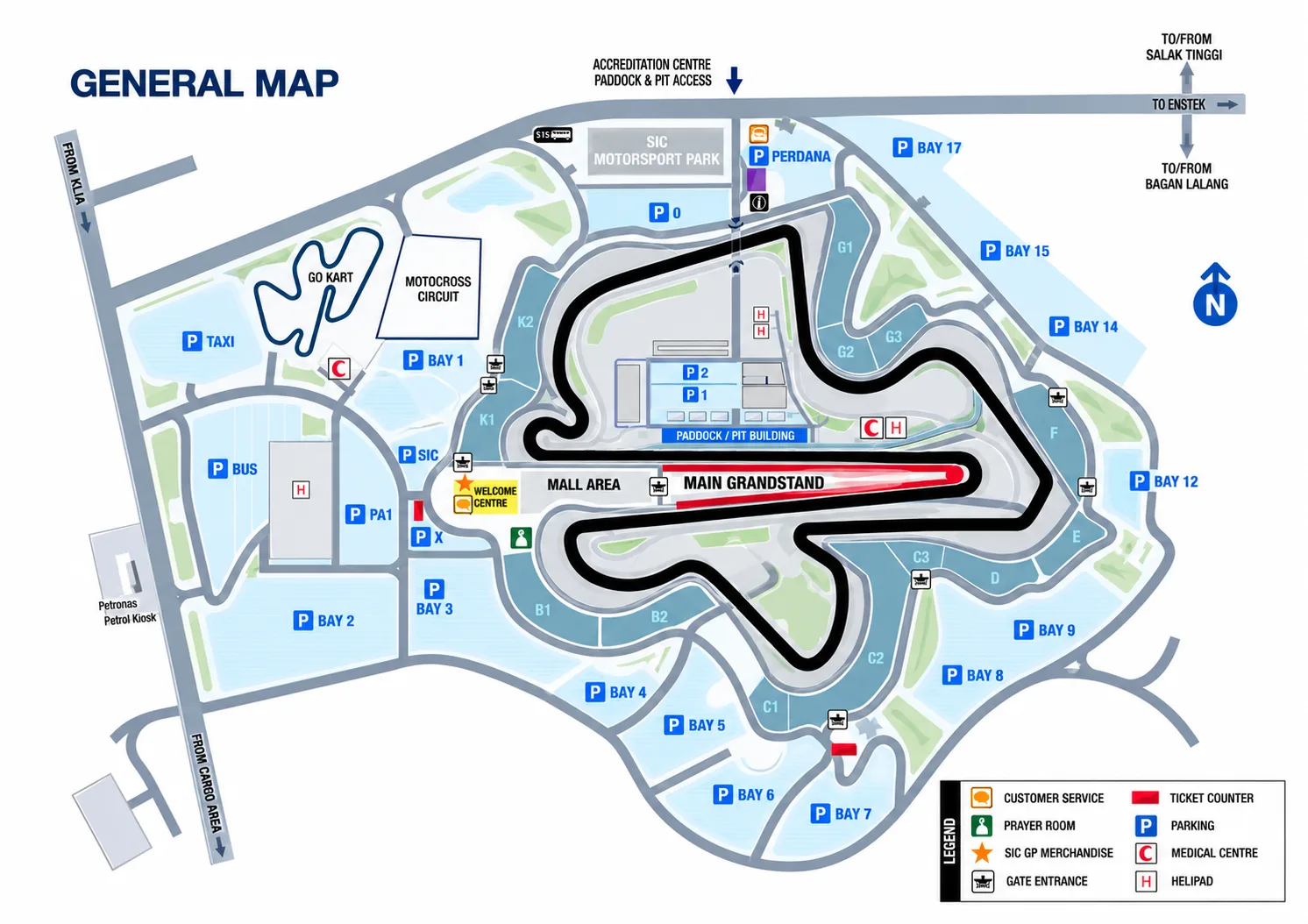
Image credit: Sepang International Circuit – General Map
The map gives you a useful overview of the entire circuit, including the main track, Main Grandstand, K1, F, K2 and other viewing areas, as well as parking, entrances, the Welcome Centre and surrounding facilities.
The circuit's official spectator maps also show multiple parking areas, shuttle stops and access points around the venue.
Tip: If you're attending F1 Sepang 2026, save the circuit map on your phone before heading to the venue. Sepang is a large site, and your parking area or entrance may not be directly beside your grandstand.
Petronas Sepang International Circuit Track Guide: Corners, Straights & Viewing Areas
The Petronas Sepang International Circuit is one of Malaysia's most recognizable motorsport venues and returns to the Formula 1 calendar for the 2026 Bahrain Grand Prix in Malaysia.
The circuit combines long straights, heavy-braking zones and fast flowing corners, creating different racing and viewing experiences around the track.
For first-time F1 fans, here's a simple guide to understanding the Sepang layout.
Petronas Sepang International Circuit at a Glance
| Circuit Detail | Information |
|---|---|
| Circuit length | 5.543 km |
| Corners | 15 |
| Right-hand corners | 10 |
| Left-hand corners | 5 |
| Straights | 8 |
| 2026 F1 race | 56 laps |
| Race distance | Approximately 310.4 km |
Instead of memorising every corner individually, it is easier to understand Sepang in four main sections.
Turns 1–4: Heavy Braking & Opening-Lap Action
The lap begins with one of Sepang's most important braking areas. Cars accelerate along the main straight before braking heavily into Turn 1, immediately followed by the tight Turn 2.
The opening section continues through the sweeping Turn 3 before another braking zone at Turn 4.
What to watch:
Turn 1 : Heavy braking and opening-lap battles
Turn 2 : Tight corner immediately after Turn 1
Turn 3 : Cars accelerate through a long sweep
Turn 4 : Another braking opportunity
The wide circuit allows drivers to use different racing lines, making the opening sequence particularly interesting when cars are running close together.
Turns 5–8: Sepang's Fast Flowing Section
The character of the circuit changes through Turns 5–8. Instead of the slower braking zones at the beginning of the lap, this section is about maintaining speed and positioning the car through a sequence of fast corners.
Turns 5 and 6 are particularly important because the cars change direction at high speed. Turns 7 and 8 continue the flowing section before the cars prepare for the slower Turn 9.
For spectators, this section provides an opportunity to see the speed, direction changes and aerodynamic performance of an F1 car.
Turns 9–11: The Technical Section
At Turn 9, the cars slow considerably after the faster middle section. This creates a very different visual experience from Turns 5–8.
Turns 10 and 11 then form a technical transition as drivers balance braking, steering and acceleration before entering the final part of the circuit.
Turns 12–15: Fast Corners, Back Straight & Final Hairpin
The final section begins with the fast Turns 12 and 13 before drivers prepare for Turn 14. A strong exit from Turn 14 is important because it leads onto the long back straight.
At the end of that straight is Turn 15, Sepang's distinctive final left-hand hairpin. Cars brake heavily before turning through the hairpin and accelerating back onto the main straight.
This creates the sequence:
Fast Corners→ Turn 14 → Back Straight → Heavy Braking→ Turn 15 → Main Straight
Turn 15 is one of the circuit's important racing areas because drivers arrive after a long period of acceleration.
Where Are the Main Overtaking Areas?
Sepang's combination of wide track sections, long straights and heavy braking creates several opportunities for close racing.
Key areas to watch include:
| Area | What to Watch |
|---|---|
| Turn 1 | Heavy braking after the main straight |
| Turns 1–2 | Opening-lap battles |
| Turn 4 | Braking after acceleration through Turn 3 |
| Turn 9 | Transition into a slower technical section |
| Turn 15 | Heavy braking after the back straight |
| Main Straight | Acceleration towards Turn 1 |
For 2026, F1's new Straight Mode and Overtake Mode systems also form part of how drivers attack and defend around the circuit.
Main Straight vs Back Straight
Sepang's two major straights play different roles.
Main Straight:
The main straight runs alongside the pit building and Main Grandstand. This is where fans can see:
- Starting grid
- Race start
- Pit lane activity
- Finish line
- Cars accelerating towards Turn 1
Back Straight:
The back straight connects Turn 14 with the final Turn 15 hairpin. Cars accelerate before braking heavily into the final corner, making this another important part of the lap for racing action.
Where Can You Watch at Sepang?
Different viewing areas provide very different perspectives.
| Viewing Area | Main View |
|---|---|
| Main Grandstand | Start/finish straight, pit lane and grid |
| K1 Grandstand | Turns 1–2 and opening-corner action |
| F Grandstand | Turns 7–8 |
| Hillstands | Open-air circuit views |
Main Grandstand:
The Main Grandstand provides views around the start/finish straight and pit lane, making it useful for following the grid, race start, pit activity and finish.
K1 Grandstand:
K1 is positioned around Turns 1–2, where cars arrive after accelerating along the main straight. This provides a different perspective on the opening-lap action and heavy braking.
F Grandstand:
F is located around Turns 7–8. Instead of focusing on the start or pit lane, this area lets spectators watch the cars through part of Sepang's flowing corner sequence.
Hillstands:
Hillstands provide a more open-air viewing experience. Because these areas are exposed, spectators should prepare for Sepang's heat, humidity and possible rain.
Always check the viewing area listed on your specific 2026 ticket because spectator access can vary by event.
Which Parts of Sepang Should First-Time Fans Remember?
You don't need to memorise all 15 corners. Start with five key areas:
Turn 1 : Heavy braking after the main straight.
Turns 5-6 : One of the circuit's fastest flowing sequences.
Turn 9 : A major change from high-speed to slower technical driving.
Turn 15 : Heavy braking after the back straight.
Main Straight : Grid, race start, pit activity and finish.
Together, these areas show the different characteristics that make up a lap of Sepang.
Sepang for F1 2026
The Formula 1 Gulf Air Bahrain Grand Prix in Malaysia takes place from 2–4 October 2026.
The Grand Prix is scheduled for Sunday, 4 October at 3:00 PM Malaysian time, covering 56 laps of the 5.543-kilometre circuit.
Schedules can change, so check the latest official F1 timetable before heading to Sepang.
Before Heading to the Circuit
Sepang is a large venue, so save the latest spectator map on your phone before race day. Check:
Grandstand → Entrance → Parking / Shuttle → Facilities → Exit Route
Your entrance or parking area may not be directly beside your viewing area, so allow enough time to move around the circuit. Understanding the track before arriving can also make it easier to follow the action once the cars are on track.
Know the corners. Find your viewing area. Experience Sepang with Senjalan.